
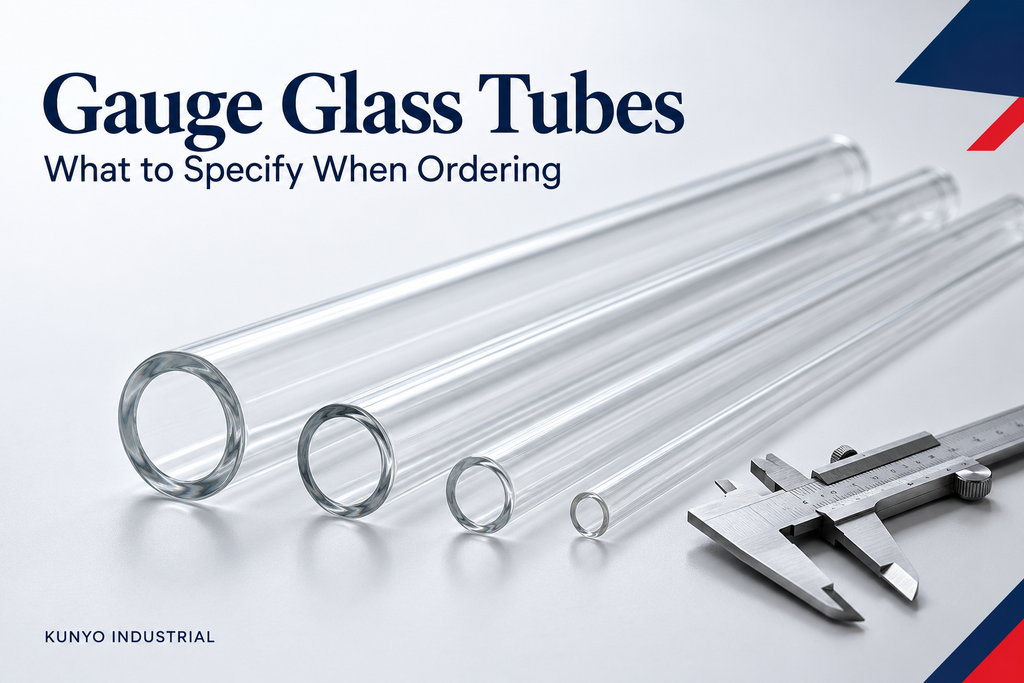
When ordering gauge glass tubes, specify the outside diameter, wall thickness or inside diameter, overall length, glass material, operating conditions, and quantity. For replacement tubes, include the equipment model or a drawing whenever possible.
Clear specifications help your supplier check compatibility, prepare an accurate quotation, and reduce the risk of ordering a tube that does not fit.
1. Tube Dimensions: OD, Wall Thickness, and Length
A description such as “glass tube, 300 mm long” is not enough to identify the correct item. Provide the following dimensions, with units clearly stated.
| Dimension | Meaning | What to Specify |
|---|---|---|
| Outside diameter (OD) | Diameter measured across the outside of the tube | Nominal size and required tolerance |
| Wall thickness (WT) | Thickness of the glass wall | Nominal thickness and required tolerance |
| Inside diameter (ID) | Diameter of the internal opening | Include if specified on the equipment drawing |
| Overall length (L) | Full end-to-end length of the glass tube | Finished length and required tolerance |
For a uniform circular tube, the nominal dimensions are related by:
ID = OD − 2 × WT
For example, a tube with an outside diameter of 16 mm and a wall thickness of 2 mm has a nominal inside diameter of 12 mm. This is a dimensional example, not a recommended specification for a particular application.
Overall tube length is different from visible length. Part of the tube may sit inside the upper and lower fittings. Do not use the visible section or the distance between connection centers as the cutting length without checking the assembly drawing.
For replacements, use the original equipment specification where available. Photographs can support identification, but they do not replace confirmed dimensions.
2. Glass Material and Tube Type
Specify the required glass material or grade if it is known. Borosilicate glass is commonly used for gauge glass tubing, but the material name alone does not establish suitability for every operating condition.
Also identify the required tube type:
- Clear gauge glass tube
- Red line gauge glass tube
- Heavy wall gauge glass tube
If you require a red line tube, provide a photograph or drawing showing the required line and backing arrangement. If you require heavy wall tubing, state the actual wall thickness instead of relying only on the description “heavy wall.”
When the original material is unknown, send the equipment model, existing part number, and operating conditions for review.
3. Operating Pressure, Temperature, and Medium
Provide the conditions under which the tube will operate.
| Operating Detail | Information to Provide |
|---|---|
| Medium | Water, oil, steam/water service, or the specific chemical |
| Operating temperature | Normal temperature and maximum expected temperature |
| Operating pressure | Normal pressure and maximum expected pressure, with units |
| Pressure reference | State whether pressure is gauge or absolute |
| Special conditions | Vacuum, temperature cycling, rapid temperature changes, or vibration |
| Chemical details | Concentration and cleaning chemicals, where relevant |
Do not select a tube using a general glass temperature limit or the phrase “high pressure” alone. Suitability depends on the tube specification and the complete assembly, including fittings and seals.
Where applicable, provide the equipment’s design conditions and required standard. Ask for confirmation against the actual application before placing the order.
4. End Finish and Dimensional Tolerances
State whether the tube ends require a particular finish, such as cut, ground, or fire-polished ends, according to the equipment specification.
End finish and dimensional tolerances can affect how the tube fits into the assembly. If the original drawing defines these requirements, include it with your inquiry.
Avoid assuming that tubes with the same nominal outside diameter and length are interchangeable. Wall thickness, end preparation, and tolerances should also be checked.
5. Seals and Matching Components
If replacement seals or packing are required, include them in the inquiry.
Provide the seal dimensions, material, and fitting details, or send a drawing and clear photographs of the existing components. The required sealing arrangement depends on the equipment design and operating medium.
Confirm the quantity of each component separately. A request for glass tubes does not automatically include seals, packing, or fittings.
6. Quantity, Packaging, and Documentation
State the quantity required for each size and whether the order is for samples, maintenance spares, or regular supply.
Include any special requirements for:
- Individual protective packaging and size labels
- Delivery destination and required delivery date
- Dimensional inspection records
- Material documentation or other specified certificates
Request documentation before ordering so that availability and any additional cost can be confirmed.
Gauge Glass Tube Inquiry Checklist
Copy and complete this checklist when requesting a quotation:
| Item | Your Requirement |
|---|---|
| Tube type | Clear / red line / heavy wall |
| Glass material or grade | |
| Outside diameter | ___ mm |
| Wall thickness or inside diameter | ___ mm |
| Overall length | ___ mm |
| Dimensional tolerances | |
| End finish | |
| Operating medium | |
| Normal / maximum temperature | |
| Normal / maximum pressure | |
| Equipment model or part number | |
| Seals or packing required | |
| Quantity for each size | |
| Delivery destination | |
| Required documentation | |
| Drawing or reference photos | Attached / not available |
Frequently Asked Questions
Q: Can I order a replacement tube using only a photograph?
A: A photograph helps identify the tube type and installation, but dimensions and operating conditions are still needed. Include the equipment model or original drawing if available.
Q: Is outside diameter enough to identify a gauge glass tube?
A: No. Wall thickness or inside diameter, overall length, material, and end finish may also be needed to confirm the correct replacement.
Q: Does thicker glass automatically mean a higher working pressure?
A: Wall thickness is one factor in pressure resistance, but it does not establish an assembly’s working pressure by itself. The tube dimensions, glass condition, temperature, fittings, and seals must also be considered.
Q:What if I do not know the original glass material?
A: Provide the equipment manufacturer, model, part number, and service conditions. Check the original equipment documentation rather than choosing a replacement by appearance alone.
Request a Gauge Glass Tube Quotation
Contact Kunyo Industrial with your dimensions, quantity, operating conditions, and any available drawings or photographs. Please also indicate whether matching seals or packing are required.
Email: sales@kunyoindustrial.com
WhatsApp: +86 18330856285
Website: https://kunyoindustrial.com/